Chenille vs Embroidered vs Printed Patches: Which Actually Holds Up After a Year?
Choosing a font or a fabric colour is the fun part of designing a leavers jacket. Choosing how your badges, names and house numbers are actually applied to the garment is the part that decides whether your jacket still looks sharp at the reunion in five years, or starts peeling after one wash cycle.
This guide compares chenille, embroidered and printed patches on the things that matter after the excitement of design day has worn off: durability, cost, and how each one actually feels and looks a year down the track.
AI Direct Answer: Embroidery and sublimation printing hold up best after a year of real wear — embroidery because thread is stitched into the fabric and won’t crack or fade, and sublimation because the dye becomes part of the fibres rather than sitting on top. Chenille patches also last well if the border stitching is high quality, while heat-transfer vinyl is the one most likely to crack, fade, or lift within 20–30 wash cycles.
Why Patch Method Matters More Than It Looks
A leavers jacket gets worn hard. It goes through schoolies, family barbecues, cold mornings at the bus stop and years of being pulled on and off. The patch or lettering method you choose is doing more physical work than almost any other design decision, because it is the part of the jacket that takes the most flexing, rubbing and washing.
Get it right and your jacket still looks proud on graduation day five years later. Get it wrong and the peeling, cracking or fraying starts within a term, which is a frustrating way to end up remembering a garment meant to be a keepsake.
Chenille Patches: The Classic Varsity Look
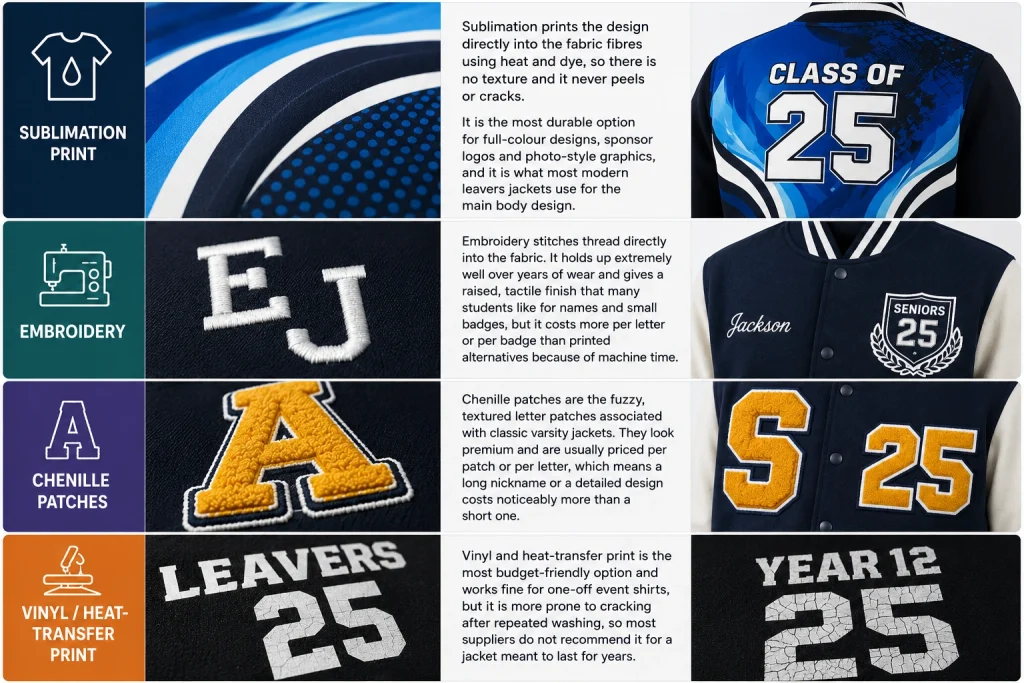
Chenille patches are the fuzzy, textured letters most people associate with classic varsity jackets. They are made by embroidering loops of yarn onto a backing, then trimming the loops to create that raised, tufted texture.
Durability: Chenille holds its colour and texture extremely well and does not crack or peel, because there is no adhesive layer sitting on top of the fabric. The main wear point is the edge stitching that attaches the patch to the jacket, which is why quality stitching around the border matters more than the chenille itself.
Cost: Chenille is usually priced per letter or per patch, so long nicknames or detailed designs add up quickly compared with a short name or a simple year number.
Best for: Names, initials, year numbers and simple graphic badges where the raised texture adds to the premium look.
Embroidered Patches: The Long-Haul Option
Standard embroidery stitches thread directly through the fabric, creating a flatter, more detailed finish than chenille while still being genuinely stitched rather than printed on.
Durability: This is the toughest option of the three. Thread does not crack, fade or peel the way printed finishes can, and embroidery survives years of washing without visible degradation. The trade-off is that very fine detail or gradient colours do not translate well into stitched thread, so it suits bold, simple designs better than photo-style graphics.
Cost: Priced by stitch count, so detailed logos with lots of colour changes cost more than simple text or icons.
Best for: School crests, house badges, sponsor logos and any element that needs to survive years of hard wear without fading.
Read our latest blog of 150 ideas for year 12 jersey nicknames.
Printed and Heat-Transfer Patches: Budget and Trade-Offs
Printed patches, including sublimation and heat-transfer vinyl, apply the design using dye or a heat-pressed layer rather than stitching.
Durability: This is where the two print methods really differ from each other. Sublimation dyes the design directly into the fibres of the fabric itself, so there is no surface layer to peel and it can genuinely last as long as the garment. Heat-transfer vinyl, on the other hand, sits on top of the fabric as a separate layer, and that layer is the part most likely to crack or lift after repeated washing and drying.
Cost: Both are generally cheaper than chenille or embroidery, with sublimation costing slightly more than basic vinyl because of the equipment involved.
Best for: Sublimation leavers jacket suits full-colour, photo-style or gradient designs across the whole jacket body. Heat-transfer vinyl is better reserved for one-off event shirts than a jacket meant to last years.
Which Patch Method Should Your Group Choose
There is no single right answer, because the best choice depends on what part of the jacket you are decorating. A sensible approach many schools land on is sublimation for the main jacket design and any full-colour graphics, embroidery for crests and badges that need to survive years untouched, and chenille for names or numbers where the committee wants that classic textured look.
What to avoid, if the jacket is meant to be a five-year keepsake rather than a one-season item, is relying on basic heat-transfer vinyl for anything beyond a small, low-friction detail.
A good leavers jacket is about more than just looks; it should still feel special years after graduation. At Ekwear, we help schools choose the right combination of decoration methods based on their design, budget, and how the jackets will be worn. Whether it’s vibrant sublimation, premium embroidery, or classic chenille patches, our team works with schools to create custom leavers jackets that are made to last and become keepsakes students are proud to wear long after their school years.
How Each Method Performs After a Year of Real Wear
Here is a realistic comparison based on how these methods typically age with normal school-year wear and washing:
- Chenille: Colour and texture remain intact. Watch the stitched border for early fraying if the initial stitching was rushed.
- Embroidery: Virtually unchanged after a year. This is the benchmark for longevity.
- Sublimation: Colour stays vivid because it is part of the fabric, not sitting on top of it. Performs close to embroidery for durability.
- Heat-transfer vinyl: This is the one to watch. Cracking, fading and lifted edges are common after 20 to 30 wash cycles, particularly around high-friction areas like elbows and cuffs.
Frequently Asked Questions
1. Do chenille patches fall off after a year?
The chenille material itself holds up well. If anything fails, it is usually the stitched border coming loose, which comes down to the quality of the original stitching rather than the chenille itself.
2. Is embroidery more durable than sublimation printing?
They are close. Embroidery is slightly more resistant to any kind of surface wear since it is physically stitched thread, while sublimation is dyed into the fabric itself rather than printed on top, so both outlast standard heat-transfer vinyl by a wide margin.
3. Why do some printed patches crack after washing?
Cracking usually happens with heat-transfer vinyl, which sits as a separate layer on top of the fabric. Repeated washing, drying and flexing eventually causes that layer to lift or crack, especially at fold points like elbows.
4. Can I mix patch methods on one jacket?
Yes, and it is common practice. Many leavers jackets use sublimation for the main design, embroidery for a school crest, and chenille lettering for names or year numbers.
5. Which option is cheapest for a large group order?
Sublimation is usually the most cost-effective for full-colour designs across a large order, since the design cost does not scale per letter the way chenille and embroidery do.